

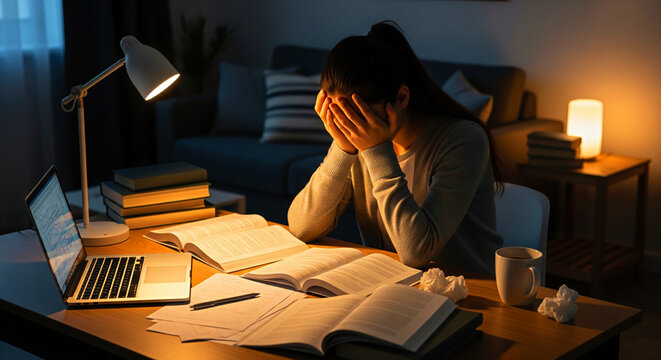
There is a point around 2:17 a.m. when an all-nighter starts feeling almost noble.
You have three browser tabs you understand, eleven you do not, a beverage containing an irresponsible amount of caffeine and the growing conviction that morning-you will somehow be more competent than current-you.
College has spent decades turning sleep deprivation into a personality trait.
Your brain remains unconvinced.
Staying awake is not the same as learning
An all-nighter can create more hours with your notes.
It cannot guarantee those hours are useful.
Sleep supports attention, memory and learning. When you are severely sleep deprived, reading the same paragraph six times is technically studying in the same way standing in a kitchen is technically cooking.
You may be awake.
Your brain is not operating at its best.
Your mood comes to the all-nighter too
Sleep loss does not just make people tired.
It can make stress feel louder, frustration arrive faster and small problems seem much more dramatic.
Research has found strong associations between inadequate sleep and mental distress. Poor sleep is also linked with depression and other health problems.
If sleep problems are persistent rather than occasional, it may be worth learning about sleep disorders instead of assuming every problem is simply “college.”
The emergency creates the next emergency
You stay up to finish Wednesday’s exam.
Thursday becomes useless.
You nap at 6 p.m.
You cannot sleep Thursday night.
Friday’s class disappears into fog.
Now you are behind again.
This is how one heroic academic rescue mission can become a three-day scheduling hostage situation.
Sometimes the better move is damage control
If you are deciding between three more hours of exhausted studying and some actual sleep, the answer will depend on the situation.
But “I have to finish everything perfectly” is not the only option.
Submit the imperfect draft.
Prioritize the concepts most likely to matter.
Email the professor if something genuinely serious has derailed you.
Make the least bad decision instead of insisting on an imaginary perfect one at 3 a.m.
Sleep is not optional even during finals, despite the campus folklore suggesting otherwise.
Notice when this stops being occasional
One ugly night before an exam is different from regularly surviving on too little sleep.
If your schedule repeatedly requires you to trade sleep for basic functioning, the problem may be the schedule.
If you have enough opportunity to sleep but cannot fall asleep, stay asleep or wake rested for weeks at a time, that deserves attention too.
Talk with a health professional rather than building an increasingly elaborate relationship with caffeine.
You are allowed to be a mammal
This is perhaps college’s least inspiring truth.
You have a body.
It requires food, sleep, water and occasionally sunlight.
No amount of ambition negotiates those requirements away.
Sleeping will not write your paper.
It may, however, return the brain that has to write it.